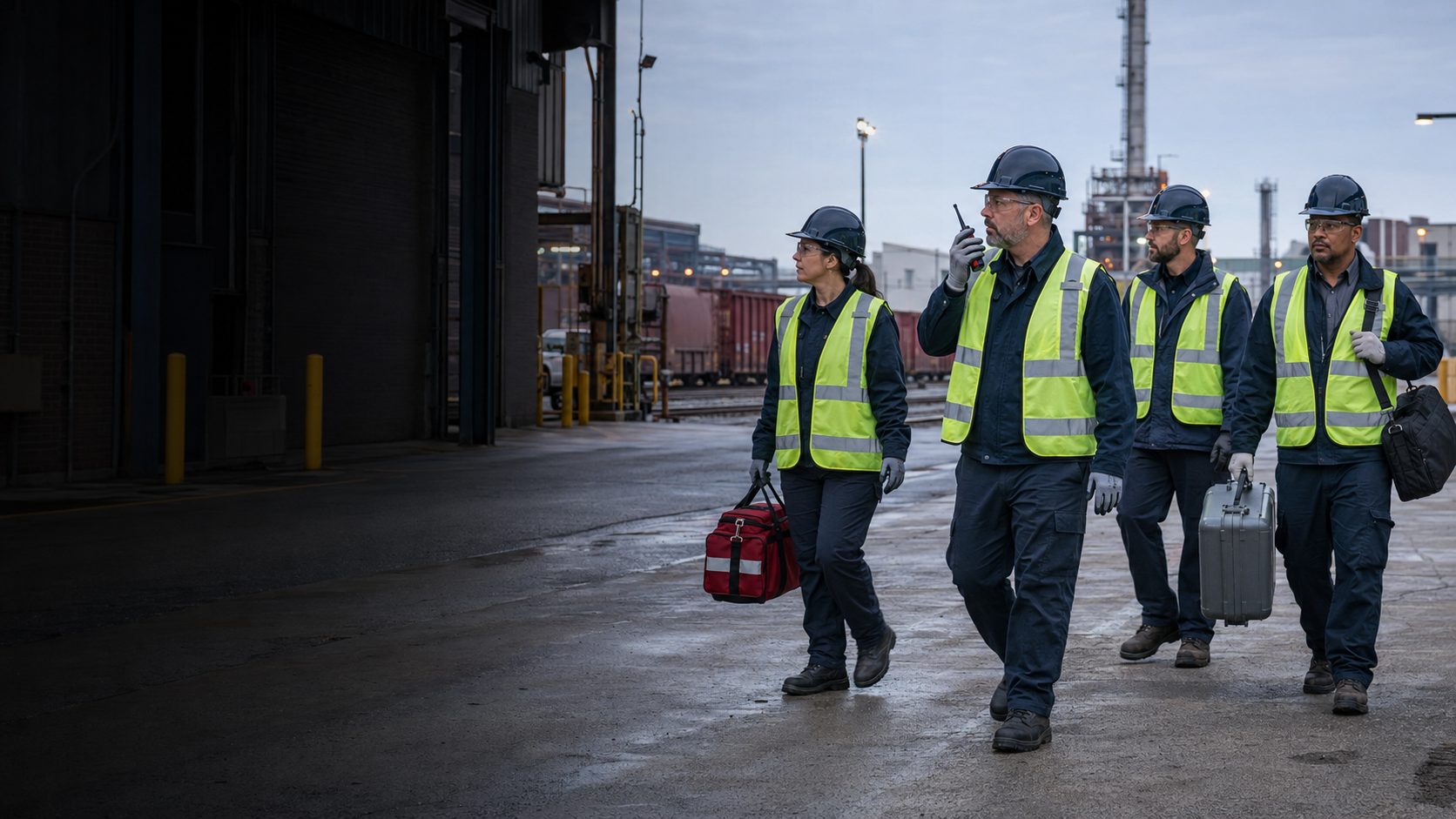
Build a team that can respond before outside help arrives.
For workplaces where EMS is more than a few minutes away, or where the first minutes decide the outcome. Structured training pathways for emergency response teams across industry, healthcare, campus, event, and security environments.
Some sites can't wait for an ambulance.
A rail yard. A remote plant. A construction site at the edge of a service area. A campus at 2 a.m. In these environments, the people who arrive first are your own staff — and what happens in those first minutes matters more than anything that follows.
A workplace first aid certificate is the legal minimum. A response team is a different capability: trained to a higher level, organized into roles, practised together, and prepared for the incidents your site actually faces.
Teams we develop.
Industrial & Corporate Response Teams
Manufacturing, rail, warehousing, construction, and field operations. Built around your site's real hazards and your distance from EMS.
Healthcare Response Teams
In-facility response for clinics, long-term care, and healthcare organizations.
Campus Response Teams
Post-secondary and institutional response, including overnight and low-staffing coverage.
Event Medical Response Teams
Temporary and seasonal deployments with defined scope and command structure.
Security Response Teams
Integration of medical response into existing security operations.
A pathway, not a course.
Team capability is built in layers. We assemble the combination your site needs, at the level your team can realistically sustain.
First Responder (FR)
Professional responder foundation.
Emergency Medical Responder (EMR)
Advanced pre-hospital scope.
Basic Life Support (BLS)
Heart & Stroke accredited resuscitation.
STOP THE BLEED®
Hemorrhage control, C-TECC recognized content.
Psychological First Aid
Support for teams exposed to critical incidents.
Scenario Practice
Team-based rehearsal in your actual environment.
The part most programs leave out.
Response teams see things. In industrial and rail environments especially, the same people are called to serious incidents repeatedly, and the effect accumulates quietly.
Psychological First Aid is structured, practical training in supporting a colleague in the hours and days after a critical incident — and in recognizing when someone needs more support than a colleague can provide. It is not therapy, and it does not replace professional mental health services or your EAP.
We include it in response team pathways because the team that responds to the incident is also affected by it.
Let's look at what your site actually needs.
Team pathways are scoped individually. Tell us about your site, your distance from EMS, your current coverage, and your incident history, and we'll build a pathway around it.
Discuss a Team Pathway