BLS Training Built Around the Dental Team — Not Around a Generic Classroom.
Paragon Medical designs on-site BLS and first-aid programs around your personnel, clinical environment, operating hours and emergency risks. The result is training that is easier to participate in, more relevant to daily practice and more defensible across multiple locations.
Led by an experienced Heart & Stroke instructor with extensive clinical and healthcare training experience.
Our Position on Effective Clinical Training
We adapt the learning environment, delivery schedule and clinical scenarios around the personnel we teach — not the other way around.
Standardized certification requirements do not require a standardized learning experience. The certificate is fixed. How people are taught is not.
Training quality depends on when personnel are taught, the scenarios they practise, the equipment and space available, the language and confidence levels in the room, and whether the content reflects the emergencies they may actually face in a dental setting.
The Problem With Generic Delivery
Generic delivery
- One schedule for every shift
- Examples disconnected from dental practice
- Limited connection to clinic layout and equipment
- Certification treated as the final outcome
- Inconsistent experience across locations
Paragon delivery
- Scheduling aligned with the personnel being trained
- Dental-specific medical-emergency scenarios
- Practice built around clinic roles, oxygen, AED access and team response
- Certification plus practical readiness
- A repeatable standard that can be coordinated across locations
Built for the Reality of Dental Operations
Clinical Relevance
Scenarios cover syncope, cardiac arrest, airway compromise, anaphylaxis and medical deterioration, along with team communication and EMS handover. We rehearse recognition and response within scope of practice — not outcomes we cannot promise.
Role-Based Participation
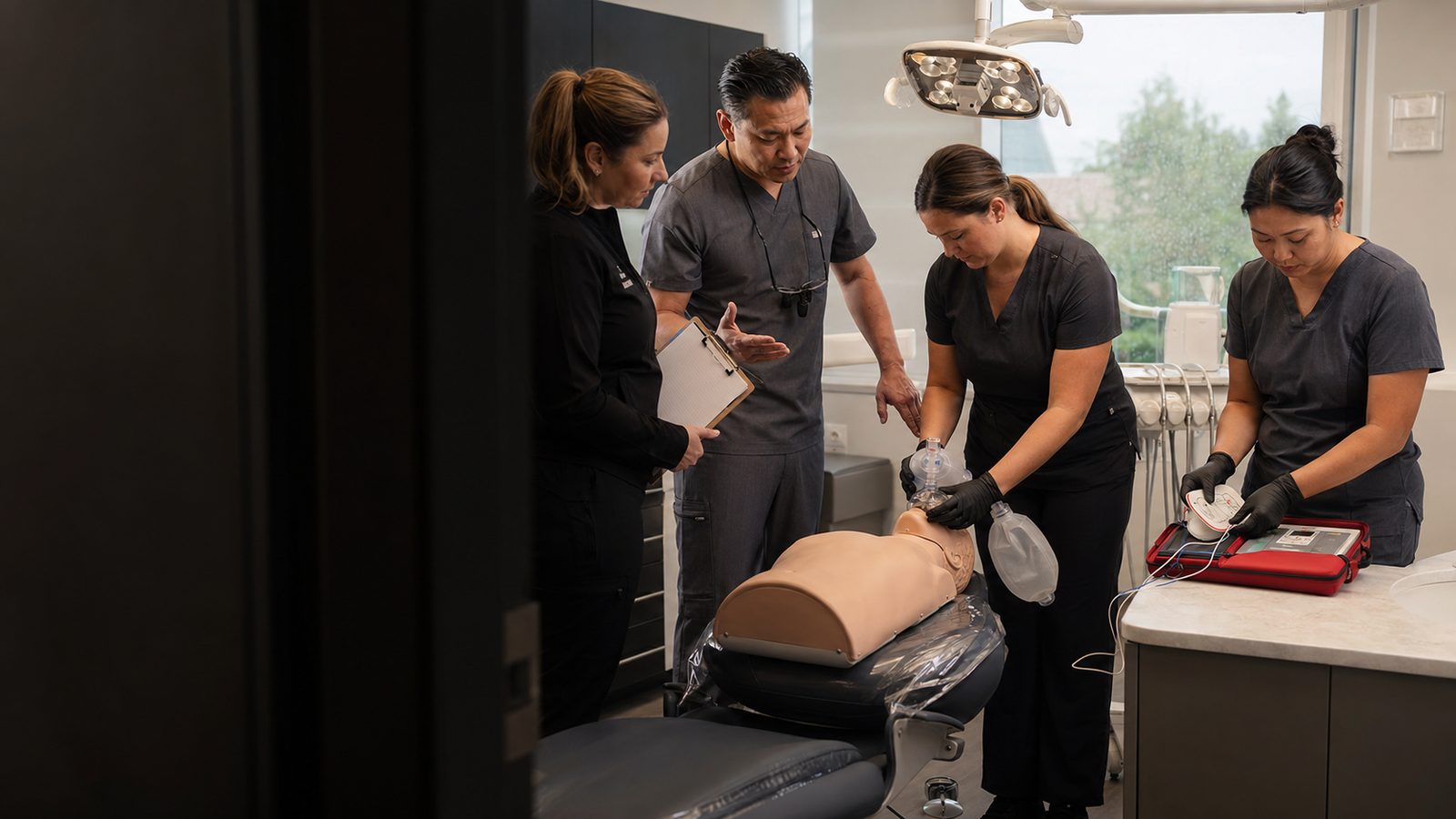
Dentists, hygienists, assistants, administrative personnel and designated responders each practise the part they would actually play: airway, compressions, AED retrieval, kit and oxygen, documentation, and meeting EMS at the door.
Learning Environment
Sessions are practical, inclusive and psychologically safe. Personnel are not tested in front of peers as a performance. Confidence and language differences are accounted for so people participate instead of observing.
Operational Scheduling
Sessions are planned around clinic hours and patient flow — before opening, over extended lunch blocks, on administrative days, or in staggered groups so part of the team stays chairside while the rest trains.
Multi-Location Consistency
Common standards, coordinated scheduling, expiry planning and a consistent learning experience, so a participant at one location receives the same standard as a participant at another.
Equipment Familiarity
Teams work with the AED and emergency oxygen equipment available in their own clinic—not only with the training devices we bring. Where equipment is available, we integrate retrieval, setup, safe use and role assignment into the session itself, so personnel know what they have, where it is and how it fits into the response. No separate equipment module is required.
Does Your Training Adapt to Your Clinic — or Must Your Clinic Adapt to the Training?
Dental practices are scheduled weeks in advance. Mandatory training is often designed around a single fixed classroom date, which forces a group to close chairs, cancel patients or send personnel off-site on their own time.
This should not be framed as weak motivation or poor engagement. It is a training-design issue, and it is solvable.
Paragon Medical delivers on-site at your practice and coordinates the session around clinic hours — before opening, over an extended lunch block, on an administrative or closure day, or in staggered groups so part of the team remains chairside while the rest trains.
For multi-location groups, the same approach is planned location by location, so each practice keeps operating while the organization moves toward a common certification standard.
Before Scheduling Mandatory Training, Confirm:
- Which personnel must be certified at each location?
- Which hours can be released without cancelling patient appointments?
- Can the team train in staggered groups so the clinic keeps running?
- Is the course practical or cognitively demanding?
- Does the schedule account for part-time and rotating clinic staff?
- Will all locations receive the same learning standard?
The Paragon Dental BLS Model
- 01
Operational Review
Locations, personnel counts, schedules, certification requirements and practical constraints.
- 02
Program Design
Delivery model, scenario set, equipment alignment and role mapping for each site.
- 03
On-Site Training
Practical instruction delivered in the clinic or another agreed setting, with your equipment where it actually sits.
- 04
Readiness Verification
Skills practice, scenario participation and a clear account of the gaps we observed.
- 05
Lifecycle Coordination
Future expiries, repeat delivery windows and location-level planning so renewals are not discovered late.
Coordination and expiry planning are delivered as a managed service between Paragon and your team. We do not promise a self-serve dashboard that is not in place.
One Standard. Multiple Locations. Fewer Operational Compromises.
Regional dental groups and DSOs need more than scattered course bookings. They need a repeatable standard, flexible delivery windows, location-aware planning, consistent documentation and a clear escalation path when a site has unique needs.
Our delivery model is designed to support multi-location organizations through a coordination model rather than a claim of trainers everywhere. We plan regional and national programs location by location, and we are direct about where scheduling constraints exist.
For larger groups, we are happy to discuss a pilot program at selected locations before any broader rollout is considered.
What We Do Not Do
- ›We do not treat every clinic as operationally identical.
- ›We do not assume every participant learns under the same conditions.
- ›We do not reduce readiness to a certificate alone.
- ›We do not force complex organizations into a one-size-fits-all delivery model.
Start With One Location — or Review the Whole Program.
Whether you are coordinating one clinic, a regional group or a larger multi-location organization, we can review your current training model, identify operational constraints and propose a delivery structure that fits your personnel and clinical environment.
Questions From Dental Decision-Makers
Can training be delivered at our clinic?
Yes. On-site delivery in your operatory or a suitable room in your building is our standard model for dental teams. We work with the space, oxygen, emergency kit and AED you actually have.
Can you work around our patient schedule?
Yes. We coordinate delivery around clinic hours — early mornings, lunch blocks, administrative days or staggered sessions — so operatories keep running and personnel train without cancelling patient care.
Can scenarios be adapted to dental practice?
Yes. Scenarios are built around emergencies that present in dental settings — syncope, airway compromise, anaphylaxis, cardiac arrest and medical deterioration — with a reclined patient, instruments in the field and your team's real roles.
Can you support multiple locations?
Our delivery model is designed to support multi-location organizations through a common standard, coordinated scheduling, expiry planning and consistent documentation. We plan coverage location by location rather than claiming a trainer in every region.
Do all participants receive the same generic class?
No. Certification standards are consistent, but the learning experience is not generic. Content, scenarios, pacing and role assignment are aligned to the personnel in the room.
Can we begin with a pilot location?
Yes. Many groups start with one or two locations, review participation and readiness outcomes, then decide on a wider rollout.